
Artificial Intelligence (AI) has moved beyond being a futuristic concept and is now a core driver of innovation in the marketing world. As businesses compete for customer attention in an increasingly digital marketplace, AI is redefining how brands connect, communicate, and convert audiences. In 2026, the role of artificial intelligence in digital marketing is more impactful than ever, shaping strategies through automation, personalization, predictive insights, and data-driven decision-making.
This blog explores how AI is transforming digital marketing in 2026, the benefits it offers, key applications, and what marketers should expect in the future.
Understanding the Role of Artificial Intelligence in Digital Marketing
The role of artificial intelligence in digital marketing revolves around enabling machines to analyze data, learn patterns, automate tasks, and make intelligent decisions with minimal human intervention. AI helps marketers understand customer behavior, predict trends, personalize content, and optimize campaigns in real time.
Instead of relying solely on intuition or manual analysis, marketers now use AI-powered tools to improve efficiency, accuracy, and ROI.
AI-Powered Personalization: The Future of Customer Experience
Personalization has become a top priority for brands, and AI makes it scalable and precise. In 2026, AI can analyze customer behavior across websites, social media, email campaigns, and purchase histories to deliver highly personalized experiences.
Key benefits include:
- Personalized product recommendations
- Customized email marketing campaigns
- Dynamic website content based on user preferences
- Targeted ads that match customer interests
The role of artificial intelligence in digital marketing here is to transform generic marketing into meaningful one-to-one customer interactions.
Content Creation and Optimization with AI
AI is revolutionizing content marketing by helping businesses generate high-quality content faster and more efficiently. AI tools can now:
- Write blog posts, ad copy, and social media captions
- Generate video scripts and visuals
- Optimize headlines for SEO and engagement
- Analyze which content performs best
In 2026, the role of artificial intelligence in digital marketing is not to replace creativity, but to enhance it—allowing marketers to focus on strategy while AI handles repetitive content tasks.
Smarter SEO and Search Optimization
Search engine optimization is evolving with AI-driven algorithms. AI tools now help marketers:
- Conduct advanced keyword research
- Analyze competitor strategies
- Predict ranking opportunities
- Optimize content for voice search and zero-click results
The role of artificial intelligence in digital marketing is crucial in understanding search intent and creating content that aligns with how users search in real time.
AI in Social Media Marketing and Community Management
Managing social media across multiple platforms can be overwhelming. AI simplifies this by automating scheduling, analyzing engagement, and optimizing content performance.
AI helps brands:
- Identify trending topics
- Determine the best posting times
- Monitor brand sentiment
- Respond to customer inquiries using chatbots
In 2026, the role of artificial intelligence in digital marketing ensures brands stay active, responsive, and data-driven on social platforms.
Chatbots and Conversational Marketing
AI-powered chatbots have become a major part of customer support and lead generation. These bots can handle customer inquiries 24/7, guide users through purchase decisions, and collect valuable customer data.
Benefits of AI chatbots:
- Instant customer responses
- Reduced support costs
- Improved customer satisfaction
- Higher lead conversion rates
The role of artificial intelligence in digital marketing in conversational tools is to enhance customer engagement while improving operational efficiency.
Predictive Analytics and Data-Driven Marketing
One of the most powerful applications of AI in marketing is predictive analytics. AI can analyze large datasets to forecast customer behavior, sales trends, and campaign outcomes.
Marketers use AI to:
- Predict future customer needs
- Optimize marketing budgets
- Identify high-converting customer segments
- Improve retention strategies
The role of artificial intelligence in digital marketing allows businesses to shift from reactive marketing to proactive and predictive marketing.
AI in Paid Advertising and Campaign Optimization
AI is transforming digital advertising by automating campaign management and optimizing ad performance in real time.
AI-powered advertising can:
- Adjust bids automatically
- Target the right audience segments
- Optimize ad creatives based on performance
- Reduce ad spend waste
In 2026, the role of artificial intelligence in digital marketing ensures that brands get maximum ROI from paid ad campaigns.
Email Marketing Automation with AI
Email marketing remains one of the highest ROI marketing channels, and AI makes it smarter and more effective.
AI helps marketers:
- Personalize subject lines and content
- Send emails at the best time for each user
- Segment email lists automatically
- Predict customer engagement levels
The role of artificial intelligence in digital marketing here is to improve open rates, click-through rates, and conversions through intelligent automation.
Voice Search, Visual Search, and Emerging AI Trends
As smart assistants and voice search continue to grow, AI is shaping how consumers find information online. Visual search tools allow users to search using images instead of text.
Emerging trends in 2026 include:
- Voice-optimized content strategies
- AI-powered video marketing
- Augmented Reality (AR) shopping experiences
- AI-driven influencer marketing insights
The role of artificial intelligence in digital marketing is expanding beyond traditional channels into immersive and interactive digital experiences.
Ethical AI and Responsible Marketing
With AI’s increasing influence, ethical considerations are becoming more important. Businesses must ensure transparency, protect customer data, and avoid biased algorithms.
Key ethical priorities include:
- Data privacy and security
- Transparent AI decision-making
- Responsible use of customer data
- Maintaining authenticity in automated content
The role of artificial intelligence in digital marketing must balance innovation with responsibility and trust.
Challenges of AI in Digital Marketing
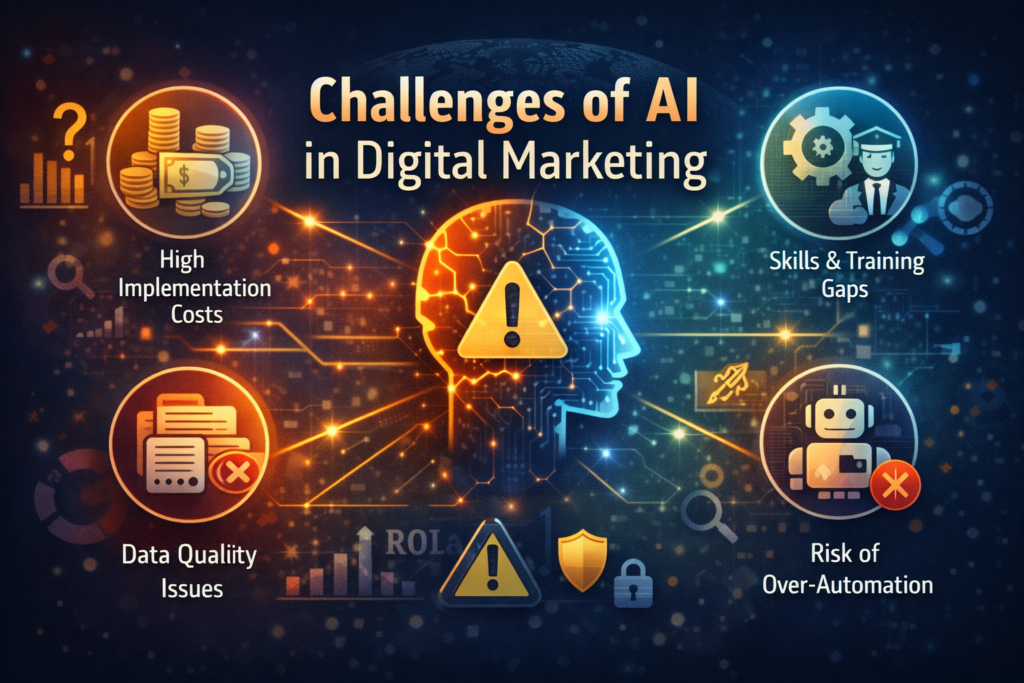
While AI offers many benefits, it also comes with challenges:
- High implementation costs
- Dependence on data quality
- Skills gap in AI and analytics
- Risk of over-automation
However, brands that invest in AI training and infrastructure can overcome these challenges and gain a competitive edge.
The Future in Role of Artificial Intelligence in Digital Marketing
Looking ahead, AI will continue to redefine how businesses market their products and services. Marketers will increasingly rely on AI for strategy development, campaign optimization, customer insights, and creative support.
In the coming years, the role of artificial intelligence in digital marketing will focus on:
- Hyper-personalized customer journeys
- Real-time marketing decision systems
- Fully automated marketing funnels
- Enhanced human-AI collaboration
AI will not replace marketers—it will empower them to become more strategic, creative, and data-driven.
Conclusion
The role of artificial intelligence in digital marketing in 2026 is transformative, reshaping every aspect of how brands connect with customers. From personalization and content creation to predictive analytics and campaign optimization, AI enables marketers to work smarter, faster, and more effectively.Businesses that embrace AI today will be better equipped to compete, innovate, and thrive in the digital future. As AI technology continues to evolve, digital marketing will become more intelligent, customer-centric, and performance-driven than ever before.